

To ensure your Nissan keeps running strong without big problems for years to come, you need to regularly check the fluid levels. Different mechanical systems use special fluids to keep things such as engine components properly lubricated, at the correct temperature or otherwise working as they were designed. When the fluid levels become too low, you risk different systems not operating correctly, or even serious mechanical damage that could result in an expensive repair job.
For all of these reasons, you should be checking the fluids in your Nissan at least once a month. If you drive the vehicle often, check out the fluid levels once a week to be on the safe side. Also, before setting out on a long trip, look at the fluids the day before to ensure everything runs smoothly while you’re gone.
Check Oil Level
The most common and perhaps one of the easiest fluids to check is the engine oil. First, make sure your vehicle is on level ground to ensure a true reading. Next, you need to locate the dipstick in the engine compartment (usually, the yellow handle gives it away), then pull on the handle and remove the entire thing. Wipe it clean with a rag or paper towel, the reinsert the dipstick all the way and remove it again. The key is to read where the oil sits on the end of the dipstick, because you want it to be somewhere between the top and minimum fill lines. Anything less than that means the vehicle needs more oil.
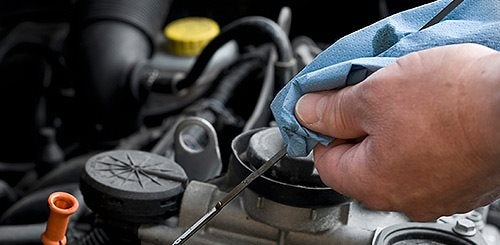
Check Transmission Fluid
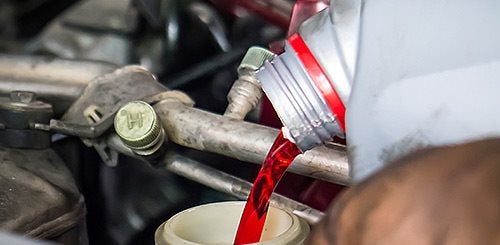
Check your transmission fluid levels the same way you would check your oil levels, except your car should be running when you check. It’s actually best to drive the vehicle for about 10 minutes to warm the fluid up properly. Next, locate the transmission fluid dip stick towards the front of the engine compartment (usually has a black handle), then press the tab on the dipstick to release the lock. Next, pull on the handle and remove the entire thing, just like the oil dip stick. Your transmission fluid should be red in color, not brown. If your fluid is brown or smells burnt, it’s time to replace it.
Check Coolant Level
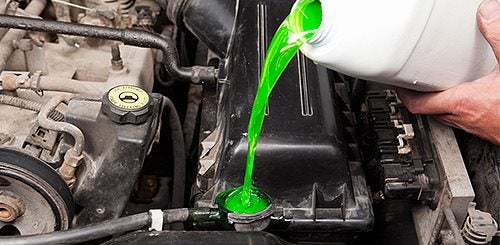
Engine coolant is even easier to check. The big key is to check the level when the engine is cold, because when it’s hot doing so can be dangerous and you won’t get an accurate reading. All you need to do is locate the overflow reservoir, which is a plastic bottle-like container that’s actually see-through. It has levels printed on the side, so you simply look at where the coolant sits in the reservoir and compare it to the lines.
Check Power Steering Fluid
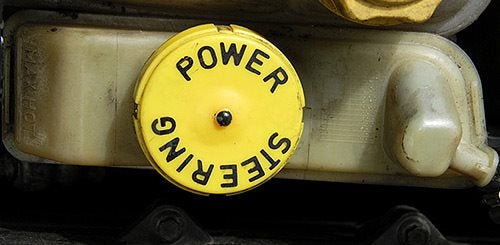
With the power steering fluid, you also need to check it when the car’s cold. Unscrew the cap and remove it. A fluid level gauge is actually attached to the underside of the cap, with maximum and minimum marks. This means you can quickly and accurately tell if more fluid is needed. Remember to screw the cap back on all the way when you’re done, and never allow any contaminants to get into the reservoir.
Check Brake Fluid
Checking the brake fluid is similar to the coolant since it’s located in a see-through plastic container. The car doesn’t need to be cold, making it even more convenient. First, locate the brake master cylinder reservoir. It’s usually located near the back of the engine compartment and looks like a small transparent tank. Without removing any caps, you can visually tell where the fluid levels are in relation to the measurement lines. If the fluid is near or below the minimum line on the container, remove the cap and refill until it reaches the maximum line.

Check Windshield Washer Fluid
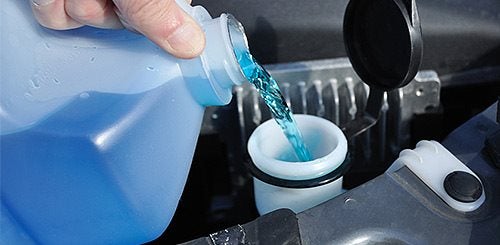
The windshield washer fluid container will be located on either side of the engine compartment in a reservoir, similar to the brake and coolant fluids. It will generally be labeled Washer Fluid, and will have a small black cap. Generally, washer fluids are either blue, green, orange or purple. You can determine the current level by simply looking at it from the outside, just like the brake and coolant levels. There’s also a warning light on the dash that will illuminate whenever the reservoir is too low.
Taking proper care of your Nissan by staying on top of the fluid levels is actually a pretty easy thing to do, especially when you know how. Of course, it’s imperative that you not only fill your oil tank, but also to get periodic oil changes every 3,000-6,000 miles, depending on your make and model.
![[Facebook]](https://dealer9786.dealeron.com/blogs/745/wp-content/plugins/bookmarkify/facebook.png)
![[LinkedIn]](https://dealer9786.dealeron.com/blogs/745/wp-content/plugins/bookmarkify/linkedin.png)
![[Twitter]](https://dealer9786.dealeron.com/blogs/745/wp-content/plugins/bookmarkify/twitter.png)
![[Yahoo!]](https://dealer9786.dealeron.com/blogs/745/wp-content/plugins/bookmarkify/yahoo.png)
![[Email]](https://dealer9786.dealeron.com/blogs/745/wp-content/plugins/bookmarkify/email.png)
Connect with us
